

Running ads as a solopreneur is powerful. You control your growth, your budget, and your strategy. But it also means every mistake comes directly out of your pocket. Unlike big brands, you don’t have room for wasted spend and wasted time only.
Written by:
Sia Aijaz
Share on:


Running ads as a solopreneur is powerful. You control your growth, your budget, and your strategy. But it also means every mistake comes directly out of your pocket. Unlike big brands, you don’t have room for wasted spend and wasted time only.
Most solopreneurs think ads fail because of budget. In reality, ads fail because of structure. The creative is weak, the destination is unclear, the targeting is rushed. Ads don’t need to be complicated, but they do need to be intentional.
Before we talk about mistakes, let’s understand what is actually required for a strong ad. A good ad is built on four simple parts. These are the foundation of every ad that converts, and they decide whether someone takes action or keeps scrolling.
A clear message
- A strong visual
- A simple action
When someone sees your ad, it should quickly answer three questions in their mind:
- What is this?
- Why should I care?
- What should I do next?
If your ad can’t answer these within a few seconds, it loses attention.
In practical terms, this means your ad should include:
- One strong hook
- Simple, easy-to-read copy
- One destination (either your Website or your DMs)
- One goal (book, buy, sign up, or message)
Think of your ad like a short funnel. The ad grabs attention, the destination continues the experience, the action guides the user forward, and the result is your conversion.
The Top 3 Ad Mistakes Solopreneurs Make
1. Weak or Confusing Ad Creative
Many solopreneurs make ads that look good but don’t say anything powerful. With recent Meta updates, attention spans are even shorter — people swipe past anything that doesn’t grab them within the first 1–2 seconds. If your creative doesn’t clearly communicate the problem, you solve and the benefit you offer, people will scroll right past it.
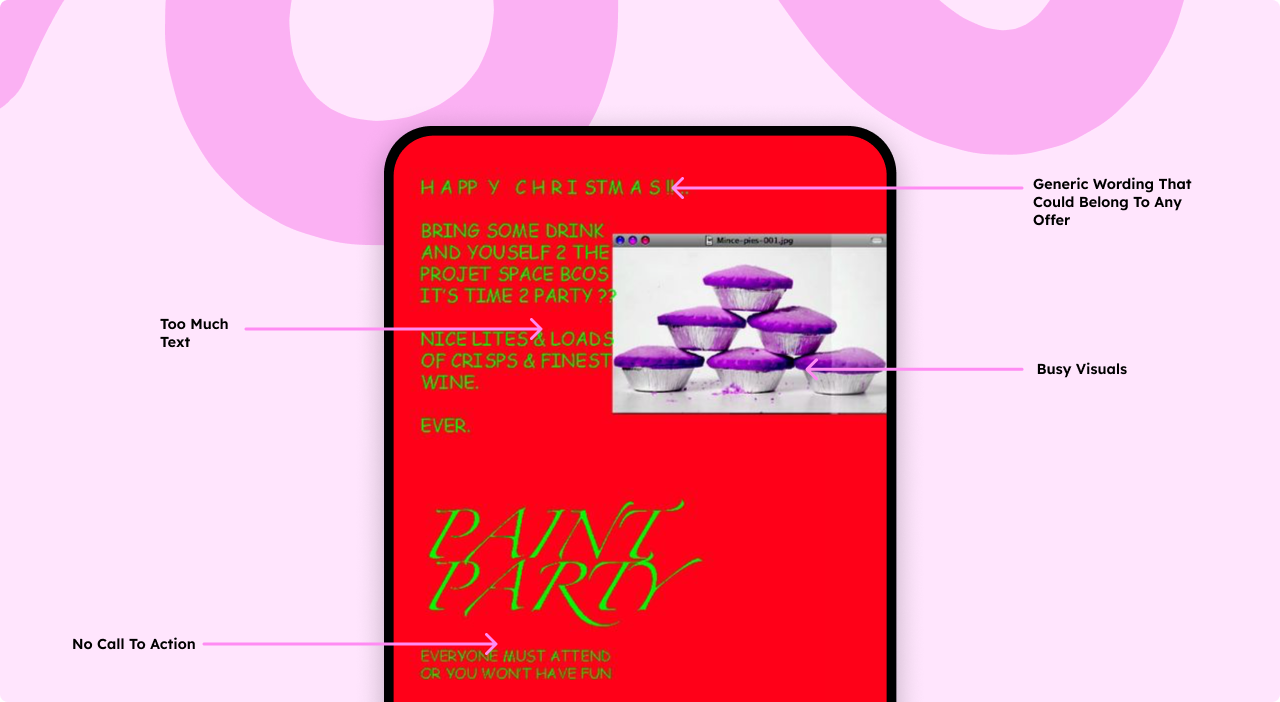
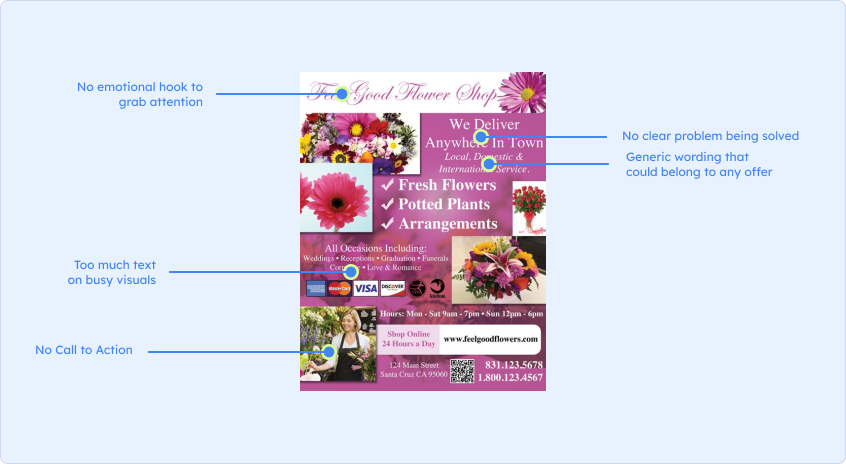
A poor creative often has mixed messages, cluttered visuals, or too much text, making it hard for viewers to understand your offer instantly. Without a strong hook, something that stops the scroll — your ad won’t even get a chance to convert.
Common signs of weak creative:
- Too much text or busy visuals
- No emotional hook to grab attention
- No clear problem being solved
- Generic wording that could belong to any offer
- No Call-to-Action
Today, Meta favors ads that are simple, relevant, and engaging. Ads that feel native to the platform — like short, clear, emotionally resonant visuals with minimal text — perform better and cost less per result.
Best Practice: Focus on quality over quantity. Your creative should deliver one strong idea:
- One main message
- One clear benefit
- One call to action
Think of your ad as a conversation starter — something that stops the scroll and makes people want to learn more — not a brochure packed with details. A great creative sets up everything that comes next: engagement, clicks, and conversions.
2. Not Matching Creative with Destination
Your ad and your destination must feel like one continuous journey. The biggest mistake solopreneurs make is showing a strong ad but not taking people anywhere meaningful. An ad that doesn’t lead to a website, a DM, or a booking page wastes all the effort spent on making a great creative, money spent on Meta and the time of a business owner by missing this single step.
If you’re running an ad, you *must* have a destination designed to capture interest. That could be:
- A landing page
- A booking page
- A DM flow
- A lead form
Without this, your ad becomes noise instead of a conversion tool. For example:
- Your ad says: “Book a free call” But the page only says: “Buy now”
This breaks trust. The user feels misled and leaves. Your destination should continue the story your ad starts. If your ad is simple, your page should be simple. If your ad promises clarity, your page should feel clear.
Best Practice:
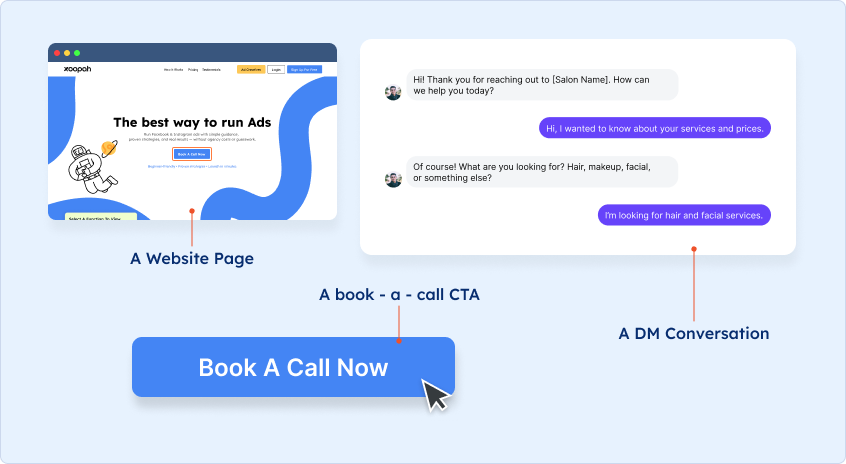
Design your destination to capture the lead. Every ad should guide people to:
- A Website page
- A DM conversation
- Or a Book-a-call page
And the message on that destination should match the promise made in your ad.
3. Running Ads Without a Clear Goal
This mistake happens when solopreneurs run ads without deciding what they actually want. They choose multiple objectives, audiences, and creatives without intention. Even worse, they select one campaign goal but run ads that ask for something else.
For example:
- Campaign goal = Traffic
- Ad copy = “Book a call today”
This confuses Meta’s algorithm. Meta doesn’t know whether to find people who watch, click, message, or buy. When your goal and your message don’t match, performance drops.
Solopreneurs also overbuild campaigns like this:
- 5 audiences
- 6 creatives
- 4 formats
- All launched together
This spreads the budget too thin and stops Meta from learning. Best Practice: One campaign. One goal. One intention.
Start small and stay focused:
- 1 campaign
- 1 objective
- 1 audience
- 2–3 creatives
Your ad copy, destination, and campaign objective must all point to the same action. When your intention is clear, Meta understands your campaign better. When Meta understands your campaign better, your results improve faster.
Final Thoughts
Ads are not magic. They are systems. And systems work when each part is intentional.
Solopreneurs don’t fail at ads because they’re bad marketers. They fail because they try to do everything at once without structure. Start simple, create clarity. Let data guide decisions. Your ad doesn’t need to be perfect. It needs to be focused. When your creative is clear, your destination matches, your goal is defined, and your optimization is patient, ads stop feeling like gambling and start feeling like growth.


